
Calibration
MASSCAL is the DAkkS-accredited calibration laboratory for mass of Häfner Gewichte GmbH. We calibrate test weights and weight sets with traceability to national standards and document the results in a DAkkS-accredited calibration certificate.
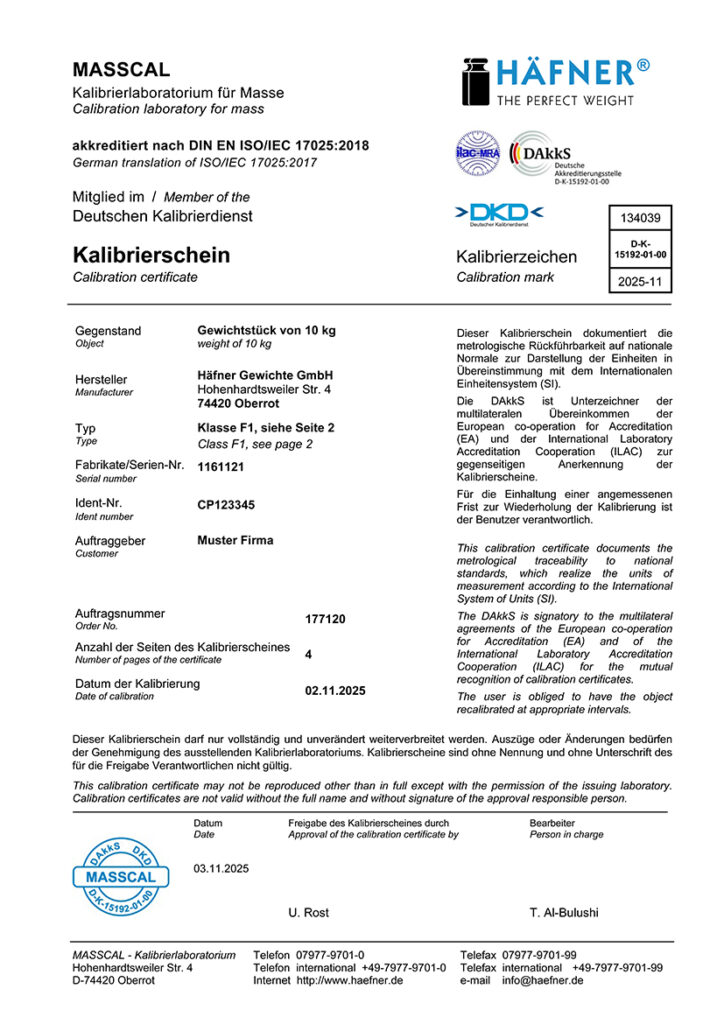
DAkkS-accredited calibration certificates confirm metrological traceability to the International System of Units (SI). They are issued on the basis of DIN EN ISO/IEC 17025 and are internationally recognized through the multilateral agreements of EA and ILAC.
DAkkS-accredited calibration of Test Weights
A DAkkS-accredited calibration certificate contains the essential information required for the clear assessment of the calibrated test weight or weight set. Depending on the scope, this includes, among other things:
- Description of the calibrated test weights
- Information on material and density
- Measured magnetic properties, e.g. susceptibility and polarization
- Conventional mass value and/or mass
- Measurement uncertainty
- Environmental conditions during calibration
- Optional conformity statement confirming compliance with the specified accuracy class
This provides users with reliable documentation for test equipment management, quality assurance, audits and recurring recalibrations.
Recalibration and Intervals
The user is responsible for defining suitable recalibration intervals. These intervals depend, among other factors, on operating conditions, accuracy requirements, frequency of use and internal quality specifications.
On request, we support you in assessing suitable inspection and recalibration intervals for your test weights and weight sets.
Recalibrating Test Weights
For recalibration, send your test weights or weight sets to MASSCAL. To ensure fast and clear processing, the weights should be submitted as completely and clearly assigned as possible.
If possible, please provide the following information when submitting or requesting recalibration:
- Customer and contact person
- Requested type of calibration, e.g. DAkkS calibration or factory calibration
- Quantity, nominal values and accuracy class of the test weights
- Assignment to weight sets, cases or boxes
- Existing calibration certificate or order numbers
- Special requirements regarding documentation or conformity statement
After goods receipt, the test weights are checked, assigned and then calibrated. For weight sets, we compare the existing markings with the previous documentation wherever possible. This allows mixed-up, missing or not clearly assignable weights to be identified and clarified with you at an early stage.
After calibration has been completed, you will receive the calibration certificate and your test weights back.
DAkkS-accredited calibration or Factory Calibration?
Which type of calibration is suitable depends on the use of the test weights, internal quality specifications and possible customer, standard or audit requirements. In principle, we distinguish between DAkkS-accredited calibration and factory calibration.
DAkkS-accredited calibration is appropriate when internationally recognized, traceable and accredited documentation is required. This is often the case in quality assurance, laboratory applications, calibration laboratories, audits or regulated areas.
Factory calibration may be sufficient if accredited calibration is not required and the test weights are mainly used for internal checks or less critical applications.
- DAkkS calibration: accredited calibration with internationally recognized traceability
- Factory calibration: practical calibration for internal testing and control purposes
- Conformity statement: optional assessment of compliance with a specified accuracy class
- Recalibration: regular repetition of calibration as part of test equipment management
We will be pleased to support you in selecting suitable test weights, weight sets, accessory solutions and calibration services for your application.
Request Calibration
Would you like to have test weights calibrated or recalibrated? Send us your request with information on nominal values, accuracy class, number of weights and the desired type of calibration. For weight sets, existing calibration certificate or order numbers help ensure clear assignment.
 English
  German